Nationwide UK Delivery
 Built in the UK
 Finance available
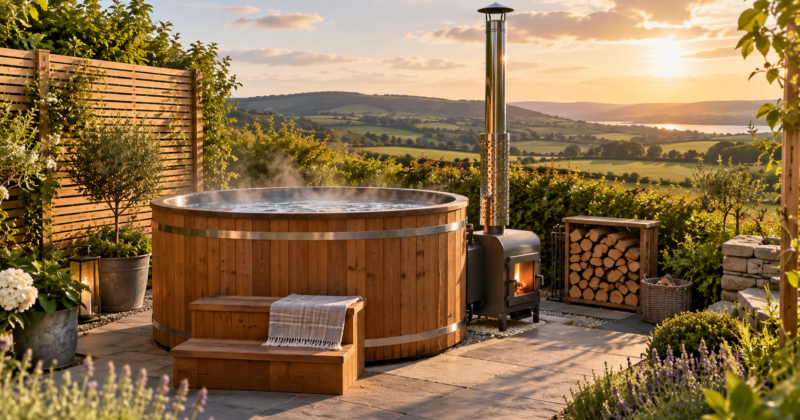
A hot tub shelter is optional, but a well chosen gazebo, pergola or privacy screen can make a hot tub far more comfortable to use all year. For a wood fired hot tub there is one rule that comes before everything else: the stove and chimney must stay clear of any roof, and the choice of shelter has to be made around them.
Picture it done well. A tub in a quiet corner of the garden, a timber screen behind you so the neighbours cannot see in, steam drifting up into a cold evening, and a spot to hang the towels where they stay dry. Done badly, you end up with a roof you cannot light the stove under, or a fence the wind whistles through.
This guide covers the options, the safety point for wood fired tubs, privacy ideas, planning rules and where to put the tub in the first place. We have been building wood fired hot tubs in the UK since 2014 and deliver across mainland Britain, so we know how these tubs sit in real gardens.
Do you need a shelter, gazebo or enclosure for a hot tub?
No, you do not need one. A hot tub works perfectly well in an open garden, and the lid keeps the heat in when you are not using it. A shelter is about comfort, privacy and looks, not about making the tub work.
Searches for hot tub shelters, gazebos, enclosures and privacy ideas are popular in the UK, according to Google Keyword Planner, because people want three things: shelter from rain and wind, privacy from neighbours, and a tub that looks part of the garden. Decide which of those matters most to you, because it changes what you should build.
- Rain and wind. A shelter helps, but it must be designed around the stove and chimney on a wood fired tub.
- Privacy. A screen, fence or planting does this job well and does not need a roof.
- Looks. A timber surround or deck can make a wood fired tub feel like part of the garden.
- Warmth. A lid and a sheltered position do more to keep water warm than a roof does. See our guide to what temperature a hot tub should be for how heat is held and lost.
Worth knowing: Enclosures sold for electric hot tubs are made for a tub with no fire. Do not assume they suit a wood fired tub.
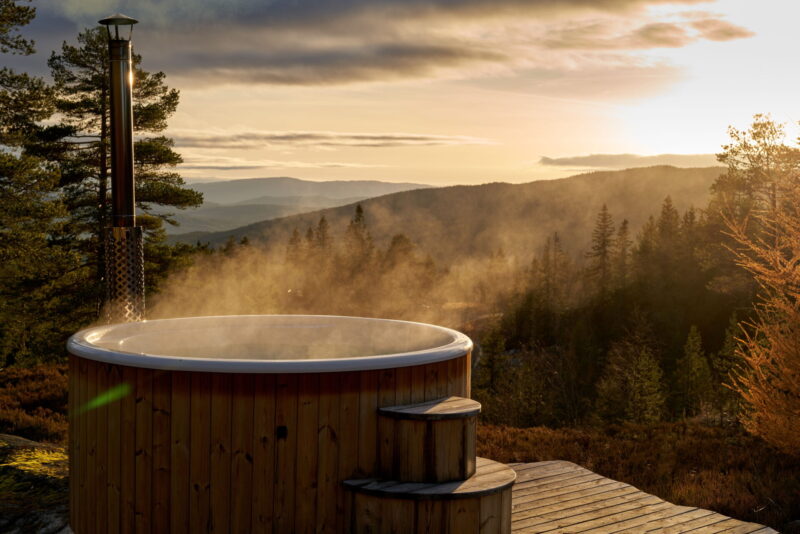
Can you put a gazebo or roof over a wood fired hot tub?
Not over the stove or chimney. A wood fired hot tub burns real wood in a stove beside the tub and vents through a chimney, so a roof, canopy or gazebo above that area is a fire risk. Our user manual says never to place a wood burning hot tub near flammable objects (user manual), and a timber or fabric roof is exactly that.
We do not publish a clearance figure for building anything over a tub, so we cannot give you a safe distance. Before you plan any roof near a lit stove, call us on 01536 606040 or send us a message and tell us the tub, the position and the structure.
- Keep the chimney in open air. The chimney needs open space around and above it. Do not enclose it.
- Avoid downdraft spots. The manual says to avoid places close to buildings or trees that can interfere with the chimney, and to check with a local stove specialist.
- Keep the stove away from fabric and timber. This includes gazebo roofs, curtains, fences and pergola beams.
- Do not use a tub in an enclosed room or shed. Smoke and heat need a clear way out.
Worth knowing: If you want cover, ask about options for the seating side only, with the stove and chimney left fully clear. We cannot approve a structure we have not seen.
Hot tub gazebo, pergola or enclosure: which is best?
For a wood fired tub, a freestanding privacy screen or a separate shelter set well back from the tub works better than a roof over it. For an electric tub, a gazebo or pergola is a popular choice. Here is how the options compare.
Hot tub shelter options compared
| Option | What it does | Suits a wood fired tub? | Main downside |
|---|---|---|---|
| Gazebo | Roof and sides over the tub | Not over the stove or chimney. Ask us first | Fire risk if the stove is under it |
| Pergola | Open frame, some shade and shelter | Not over the stove or chimney. Ask us first | Beams and climbers can burn near a stove |
| Full enclosure or hut | Walls and roof around the tub | No. Smoke and heat need open air | Trapped smoke, fire risk |
| Privacy screen or fence | Blocks sight lines and cuts wind | Yes, kept clear of the stove | Needs planning if over 2 m |
| Planting or hedge | Natural screen over time | Yes, kept clear of the stove | Takes years to fill in |
| Lid only | Keeps heat in and rain out | Yes | No privacy |
Royal Tubs guidance. Always check the position of the stove and chimney before you build.
The takeaway: for a wood fired tub, put your money into privacy and a good lid, not a roof over the fire.
How do you get privacy around a hot tub?
The simplest way to get privacy is to position the tub carefully and add a screen on the sides people can see from. Most overlooking problems come from one or two directions, so you rarely need to enclose the whole tub.
- Stand where you will sit in the tub and look around. Note every window and boundary you can see from there.
- Put the screen where it breaks those sight lines, not around the whole tub.
- Keep it well away from the stove and chimney.
- Choose a solid or slatted design. A slatted screen lets some wind through, which puts less strain on the screen than a solid one.
- Check the height against the planning rules in the next section.
- Freestanding screens. Timber or composite panels can sit on the deck or base and be moved if you change the layout.
- Fencing. A taller fence on the overlooked boundary is a lasting fix, but keep it within planning limits.
- Planting. Evergreen hedging or tall planters take a few seasons to work, and they look good while they do.
- Siting. A corner or alcove gives you two sides of privacy before you build anything. Our Ofuro is described on its page as perfect for a secluded garden alcove.
Worth knowing: Planting and screens must stay clear of the stove and chimney. Dry leaves and timber near a fire are a risk.
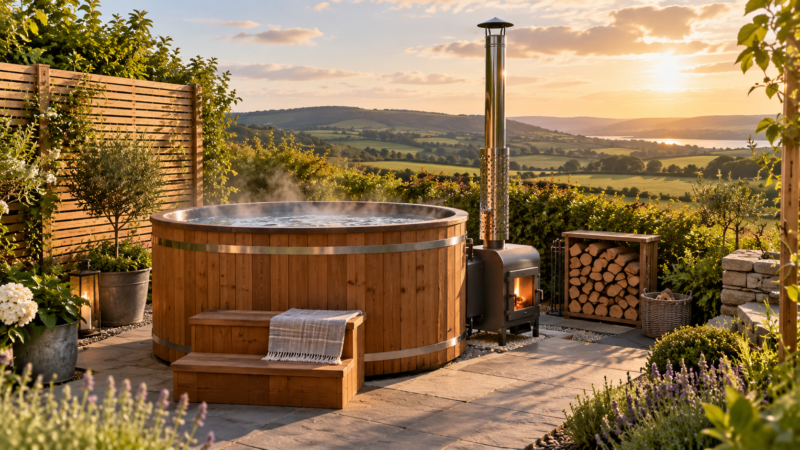
Do you need planning permission for a hot tub shelter or privacy fence?
Usually not for a small gazebo or a fence under 2 metres, but check, because rules differ for listed buildings and conservation areas. The Planning Portal says a garden gazebo or freestanding awning is an outbuilding that will often fall under permitted development if it is not in front of the house and not more than 2.5 metres high (Planning Portal).
For boundaries, the Planning Portal says a fence, gate or wall next to a highway, including a footpath, must not exceed 1 metre, and elsewhere the maximum is 2 metres. Anything taller needs planning permission, and permitted development rights can vary or be removed in conservation areas (Planning Portal).
Planning limits at a glance
| What you are building | Usual limit | Where it comes from |
|---|---|---|
| Garden gazebo or freestanding awning | Not in front of the house, up to 2.5 m high | Planning Portal, outbuildings |
| Fence, gate or wall beside a road or path | Up to 1 m | Planning Portal, fences |
| Fence, gate or wall elsewhere | Up to 2 m | Planning Portal, fences |
| Taller than these limits | Planning permission needed | Planning Portal |
Source: Planning Portal. This is a summary. Check your own address with your local council, especially in a conservation area or if you live in a flat.
Worth knowing: We are a hot tub maker, not a planning adviser. Ask your local planning department before you build, and ask us if you are unsure how a structure affects the tub.
Where should you put a wood fired hot tub?
Put it on firm, level ground with at least a 3.5 m by 3.5 m base, well away from anything flammable and with easy access to water. Our FAQ says to allow a base of at least 3.5 m by 3.5 m, which covers the tub’s 2.02 m footprint plus room to load the stove and walk around it.
A full tub is heavy. Our user manual says a wood fired tub weighs around 2 tonnes once full of water and people, and our FAQ says the surface must support up to 2,500 kg, depending on the size of tub. Concrete, decking or a flat grass patch can all work, as long as the surface is level and strong enough (FAQ).
- Choose a flat spot with room for the base and space around it.
- Check the route from the drop-off point to the tub for sills, outside taps and pipes.
- Allow room for drainage. Flower beds or a gentle slope can take the water, unless it is chemically treated.
- Keep the tub away from flammable objects, and away from places near buildings or trees that can cause downdraft.
- Think about privacy and the view at this stage, before you build anything.
Our buyer’s guide and our guide to choosing the right size help you plan the space before you order.
Worth knowing: The manual gives a different weight for the empty tub in different sections. Check the figure for your model before you plan the base, and ask us if you are unsure.
How do you protect a hot tub from wind, rain and winter weather?
Keep the lid on when the tub is not in use, take the lid and chimney off in strong winds, and sit the tub in a sheltered spot. Our user manual says to keep the lids on when the tub is not in use, and to remove the lid and chimney during powerful wind storms (user manual).
- Use the lid. It keeps rain, leaves and heat in, and it keeps children away from the water.
- Remove the steps when not in use. The manual says this keeps children away from the tub.
- Pick a sheltered position. A garden wall, hedge or screen on the windward side cuts wind, and a tub in the lee heats more easily.
- Plan for frost. See our FAQ on using a wood fired hot tub in winter.
A chimney heat guard is worth adding if children or pets will be near the stove. For the full routine, see our instructional videos.
Worth knowing: Do not leave the chimney in place in a gale. A chimney that blows over is a safety risk.
Which hot tub suits a small or secluded garden?
The Ofuro suits a small or secluded garden best, because it is our smallest tub and seats two. A larger tub takes up more of the garden, so check the base size for your model with us before you plan the space.
Royal Tubs wood fired hot tubs at a glance
| Model | Seats | Water | From | Best for |
|---|---|---|---|---|
| Ofuro | 2 | 800 l | £3,850 | Secluded corners and alcoves |
| Deluxe | 6 to 8 | 1,200 l | £4,900 | Family gardens |
| Square | 6 to 8 | 1,300 l | £6,595 | Entertaining, a squared off look |
| Wooden | 6 to 8 | 1,800 l | £3,250 | The lowest starting price, big capacity |
Source: royaltubs.co.uk product pages, October 2026. Prices change, so check each product page. Seats and water volumes are from our product specifications.
The pattern is simple: the bigger the tub, the more garden you need around it, and the more screening you will want. For a model by model comparison, see our buyer’s guide. If you run a holiday let, read our guide to hot tubs for holiday lets.
Worth knowing: Heat-up time is longer in a cold, windy spot. A sheltered position helps, and our hot tub temperature guide shows typical times for each model.
Is a hot tub shelter right for you?
A shelter or screen is right for you if you want privacy, wind protection and a tub that looks part of the garden, and you are happy to design it around the stove and chimney. It is not right if you want a full roof over a wood fired tub, because the fire risk rules that out. For that, an electric hot tub is usually the better fit.
If you are weighing it up, start with our range of wood fired hot tubs, read the buyer’s guide, or see what owners say in our customer reviews. We offer finance options and delivery across mainland Britain. Once your tub is steaming behind a screen, with the stars out and the fire crackling, you will understand the Secret of Royal Tubbing.
Talk to Royal Tubs
If you have a question about where to put your tub, screens or shelter, our team is happy to help.
- Phone. 01536 606040, Monday to Friday 9am to 5pm, Saturday 10am to 1pm.
- WhatsApp. 07310 959595
- Email. info@royaltubs.co.uk
- Showroom, by appointment. Ash Tree Farm, Stoke Albany Road, Kettering, Northamptonshire, NN14 2SP. Book a visit or send a message.
Frequently asked questions
Do you need a gazebo for a hot tub?
No. A hot tub works in an open garden with a lid. A gazebo adds comfort, but on a wood fired tub it must never sit over the stove or chimney.
Can you put a hot tub under a gazebo?
Electric tubs often sit under gazebos. A wood fired tub has a stove and chimney, so a roof above them is a fire risk. Our manual says never to place the tub near flammable objects, so call us before you plan one.
Can you put a pergola over a hot tub?
Not over the stove or chimney of a wood fired tub. A pergola with open beams still has timber close to a fire. Ask us before you build anything above the tub.
What is the best hot tub enclosure?
For a wood fired tub, a freestanding privacy screen or a separate shelter set back from the tub is better than a roof or full enclosure. For an electric tub, a gazebo or enclosure suits many gardens.
How do you add privacy to a hot tub?
Sit in the tub, note where you can be seen from, and screen those sight lines with fencing, timber panels or planting. Keep everything clear of the stove and chimney.
Do you need planning permission for a hot tub gazebo?
Often not. The Planning Portal says a garden gazebo will often fall under permitted development if it is not in front of the house and not more than 2.5 metres high. Check with your council, especially in a conservation area.
How tall can a privacy fence be without planning permission?
Up to 2 metres, or 1 metre next to a highway or footpath, according to the Planning Portal. Anything taller needs planning permission.
How much space does a wood fired hot tub need?
A base of at least 3.5 m by 3.5 m, on firm, level ground that can support up to 2,500 kg depending on the tub. That covers the 2.02 m footprint plus room for the stove.
Should I remove the lid and chimney in strong winds?
Yes. Our user manual says to remove the lid and chimney during powerful wind storms.
Can I put a hot tub in a shed or outbuilding?
We do not recommend putting a wood fired tub in any enclosed space, because it has a lit stove and chimney. Speak to us before planning any structure around the tub.
Where is the best place for a hot tub in the garden?
On firm, level ground with easy access to water and drainage, away from flammable objects and downdraft spots near buildings and trees. A corner or alcove gives you natural privacy.
Which hot tub is best for a small garden?
The two seat Ofuro, from £3,850, is our smallest model. Check the 3.5 m by 3.5 m base requirement against your space first.