Nationwide UK Delivery
 Built in the UK
 Finance available
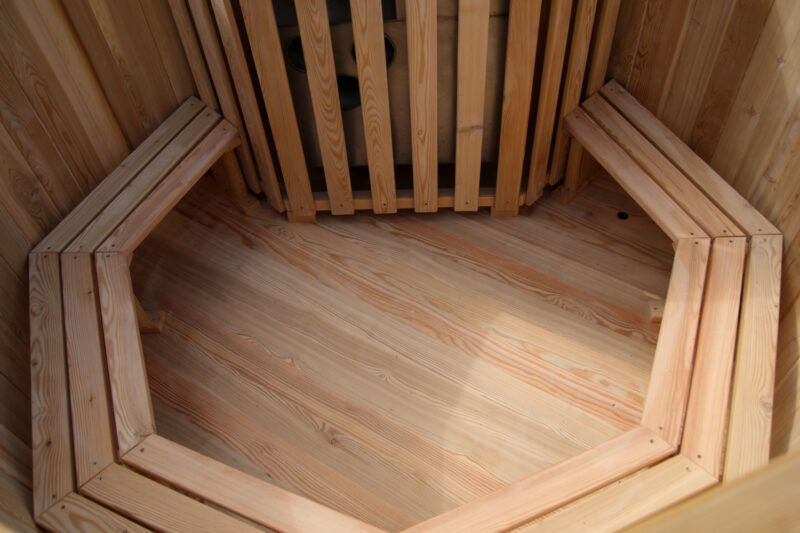
A traditional sauna should sit between 80°C and 90°C for most people, and it should never go above 100°C. If you are new to saunas, start nearer 70 to 80°C and stay for 5 to 10 minutes. Infrared saunas run much cooler, at roughly 40 to 65°C, and a steam room cooler still.
Get the heat right and the first few minutes feel like stepping into a summer afternoon. Your shoulders loosen, a light sweat starts on your back and the smell of warm spruce fills the cabin. Get it wrong and you are either sitting in a lukewarm box waiting for something to happen, or counting the seconds until you can escape through the door.
This guide gives you the figures: the right range for each type of sauna, the safe maximum, how long to stay in, and what changes for pregnancy and health conditions. It also covers how you actually set the temperature on a wood fired or electric outdoor sauna. We have been building wood fired hot tubs and saunas in the UK since 2014 and deliver across mainland Britain, so this is the advice we give our own customers.
What temperature should a traditional sauna be?
A traditional sauna should be 80 to 90°C for most adults. Klafs, a sauna maker, says the temperature of a sauna should be set between 80°C and 100°C (Klafs), while Healthline puts a typical traditional sauna at about 66 to 91°C and says it should not go above 100°C (Healthline). The UK Teratology Information Service notes that saunas typically run at 70°C to 100°C (UKTIS).
That is a wide range, and the right figure depends on how experienced you are, how long you plan to stay and how you feel on the day. Here is the full scale.
Sauna temperature guide at a glance (°C and °F)
| Sauna type | Typical temperature | Fahrenheit | How it feels |
|---|---|---|---|
| Steam room | 38 to 43°C | 100 to 110°F | Mild but humid and damp |
| Infrared sauna | About 40 to 65°C | About 104 to 150°F | Gentle, heats the body directly |
| Traditional, gentle | 70 to 80°C | 158 to 176°F | Warm and forgiving. A good starting point |
| Traditional, classic | 80 to 90°C | 176 to 194°F | Hot and sweaty. What most regular users aim for |
| Traditional, very hot | 90 to 100°C | 194 to 212°F | Intense. Short sessions only |
| Above 100°C | Above 100°C | Above 212°F | Not recommended |
Sources: Healthline (steam room and traditional sauna figures); Klafs; Nootka Saunas (infrared range). Figures are general guidance for healthy adults.
The takeaway: aim for 80 to 90°C once you are used to it, and treat 100°C as a ceiling, not a target.
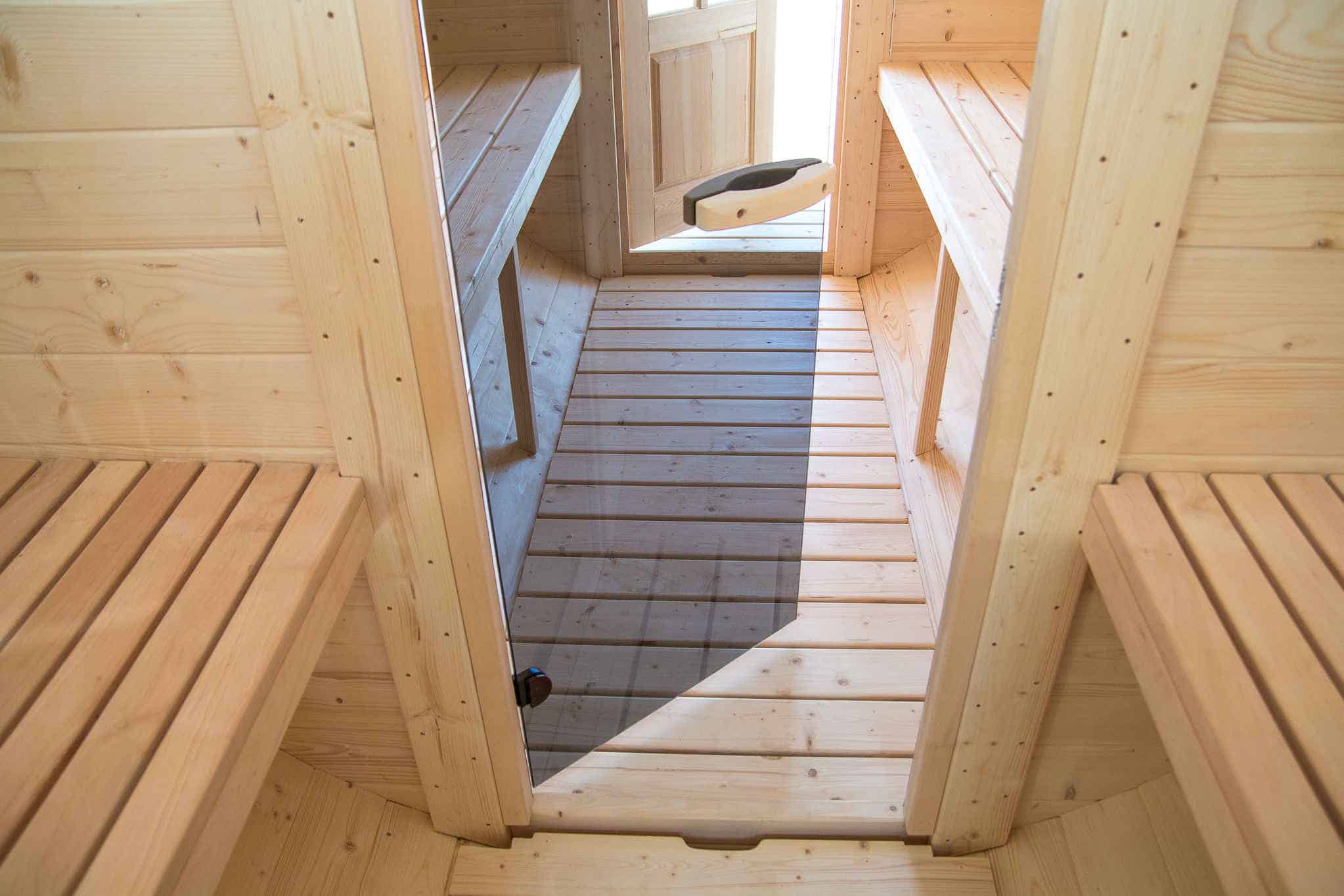
What is the best sauna temperature for a beginner?
For a beginner, 70 to 80°C is a sensible start, with a first session of 5 to 10 minutes. Healthline suggests beginners start with 5 to 10 minutes at a time and build up gradually (Healthline). You can turn the heat up a few degrees over the following weeks as your body gets used to it.
Worth knowing: The ideal temperature is the one at which you feel comfortable. Klafs says the same: a hotter, shorter round is better than sweating for longer at a lower temperature, but only if you feel well. This guide is general information, not medical advice.
What temperature should an outdoor wood fired sauna be?
An outdoor wood fired sauna should be run at 80 to 90°C, the same as any traditional sauna. The difference is that you control it with the fire, not a dial, so you need to know how to hold a steady temperature.
A wood fired stove gives a drier, softer heat than most people expect and the stones hold warmth well, but it has no thermostat. You build the temperature with the wood and then hold it by feeding the fire a little at a time. Our saunas are offered with Harvia and HUUM wood fired stoves from 8.5 kW to 20 kW, so the right size depends on the cabin you choose.
- Light the stove with dry, seasoned hardwood or kiln dried logs. Damp wood burns cool and smoky.
- Keep a steady burn going until the thermometer at bench height reads about 70°C, then add logs less often.
- Check the temperature at the level where you will sit, not at the ceiling.
- When you reach 80 to 90°C, stop feeding the fire and let the stones hold the heat.
- If it gets too hot, open the door for a minute or open the vent. Keep children and pets away from the stove while it is lit.
Our FAQ page covers firewood, delivery and care. For a sauna you have not bought yet, sauna hire is a low risk way to learn how your own stove behaves before you commit.
Worth knowing: We do not publish a heat-up time for our saunas, because it depends on the cabin size, the heater, the weather and the wood. Ask us which heater suits the size you are considering.
What temperature should an electric sauna be?
An electric sauna should also be set to 80 to 90°C, and you set it on the control panel. Electric heaters are the easy option: choose a temperature, wait for it to heat and check it with a thermometer, because a panel reading can be a few degrees out.
Our saunas are offered with electric heaters from 4.5 kW to 9 kW, including the Harvia Vega, Harvia Cylindro, HUUM Drop and HUUM Hive Mini. A bigger cabin needs a bigger heater, so match the kilowatts to the size you choose. An electric heater must be installed by a qualified electrician, which our FAQ says should be arranged before delivery.
- Why choose electric? You can set a number and walk away.
- Why choose wood fired? There is no electrical supply to arrange, and many people enjoy the fire and the crackle.
- Which is hotter? Neither. Both reach the same 80 to 90°C. The choice is about convenience, not heat.
Worth knowing: If you want to be able to heat your sauna in ten minutes of effort without handling logs, electric suits you better.
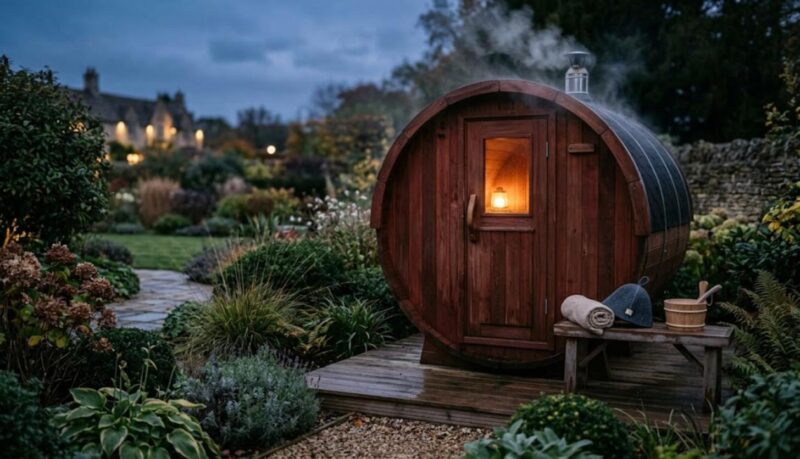
What temperature should an infrared sauna be?
An infrared sauna runs cooler, at roughly 40 to 65°C. Infrared panels warm your body directly instead of heating the air, so the cabin does not need to be as hot. Healthline notes that infrared saunas radiate heat that warms your body directly and can work at lower temperatures (Healthline), and Nootka Saunas gives a typical range of about 38 to 65°C (Nootka Saunas).
That is why a sauna and an infrared cabin are not directly comparable. A reading of 55°C is normal in an infrared sauna and would feel barely warm in a traditional one. The saunas we build are traditional, heated by a stove, so the figures in this guide apply to them.
What is the maximum safe sauna temperature?
The maximum safe sauna temperature is generally treated as 100°C (212°F). Healthline says a traditional sauna should not be more than 100°C (Healthline). Some sources mention temperatures of up to 120°C in Finland, but that is not a target for a home sauna and not one we would recommend.
- Signs you are too hot. Dizziness, a pounding heart, nausea, a headache or feeling faint. Leave straight away, sit somewhere cool and drink water.
- Why more heat is not better. Beyond 100°C you do not gain anything useful, and you raise the risk of dehydration and burns.
- Do not trust one reading. Check your thermometer, and remember that the top bench is hotter than the bottom one.
- Do not use a sauna after alcohol. Our FAQ and Healthline both say to avoid it.
Worth knowing: Healthline lists alcohol, some medicines and several health conditions as reasons to avoid or take care in a sauna. If in doubt, ask your GP.
How long should you stay in a sauna?
Stay for 5 to 10 minutes if you are new, and no more than 15 to 20 minutes in one session if you are used to it. Our FAQ recommends a maximum of 15 to 20 minutes per session, and Healthline advises against more than 20 to 30 minutes at a time (Healthline). The hotter the sauna, the shorter the round.
How long to stay at each temperature
| Sauna temperature | Suggested time | Then |
|---|---|---|
| 70 to 80°C | 10 to 15 minutes | Step out, cool down and drink water |
| 80 to 90°C | 10 to 15 minutes | Rest for 10 minutes before going back in |
| 90 to 100°C | 5 to 10 minutes | Cool down fully before another round |
| Beginner, any temperature | 5 to 10 minutes | Build up slowly over several sessions |
Royal Tubs guidance, based on our FAQ and Healthline. Leave sooner if you feel dizzy, sleepy or uncomfortable.
- Drink a glass of water before you go in.
- Sit on a lower bench first, because the top bench is hotter.
- Leave as soon as you feel too hot, not when you have hit a time.
- Cool down for a few minutes and drink water before another round.
Regular warm sessions can be part of a relaxing routine. Read more in our guide to outdoor wooden sauna health benefits.
What sauna temperature is safe for pregnancy, children and health conditions?
If you are pregnant or have a health condition, speak to your doctor, midwife or GP before using a sauna. Our FAQ says not to use a sauna if you are pregnant, and to check with your GP first if you have diabetes, heart disease or another blood pressure condition.
The UK Teratology Information Service, funded by the UK Health Security Agency, says there is no yes or no answer on pregnancy. Its factsheet says the concern is that your body temperature could rise to around 40°C, and that women who still choose to use a sauna may limit their time and reduce the temperature (UKTIS).
- Pregnancy. Ask your midwife or GP first. If you are advised it is fine, keep the heat and the time low.
- Heart conditions and blood pressure. Healthline lists heart disease and very high or low blood pressure as reasons to take care. Ask your GP.
- Asthma and breathing conditions. Healthline lists these as conditions where you may need to avoid saunas.
- Children. We do not publish a safe temperature for children in a sauna. Ask your GP before letting a child in, and never leave a child unsupervised.
Worth knowing: This is a summary, not medical advice. Your doctor is the right person to ask.
How do you check the temperature of a sauna accurately?
Use a sauna thermometer fixed at bench height, about where your head will be, and read it before you sit down. Heat rises, so the air near the ceiling is hotter than the air at your feet, and the top bench can be many degrees hotter than the bottom one.
- Fit a sauna rated thermometer on the wall at seated head height, away from the stove.
- Wait until the reading has settled before you go in. A cabin that is still heating will keep climbing.
- Sit on the lower bench for the first round. Move up only when you are comfortable.
- Do not rely on how it feels. If you feel unwell, leave, whatever the number says.
A thermometer that also shows humidity is a useful extra. Our sauna range is built from spruce with alder and linden benches, which are woods commonly used in saunas because they stay comfortable to sit on.
Worth knowing: A wooden bench that looks cool can still burn bare skin at the top of a hot sauna. Sit on a towel.
Which Royal Tubs sauna suits the temperature you want?
Each of our three saunas is offered with an electric or a wood fired heater, and the price depends on the size and heater you pick.
Royal Tubs saunas and heater options
| Model | From | Sizes | Electric heaters | Wood fired heaters |
|---|---|---|---|---|
| Barrel Sauna | £7,650 | 160 to 450 cm | 4.5 to 9 kW | 8.5 to 20 kW |
| Iglu Sauna | £8,030 | 160 to 450 cm | 4.5 to 9 kW | 8.5 to 20 kW |
| Square Sauna | £9,200 | Up to 450 cm | 4.5 to 9 kW | 8.5 to 20 kW |
Source: royaltubs.co.uk product pages, October 2026. Prices and options change, so check each product page. The Square Sauna seats up to 6.
The pattern is simple: a bigger cabin needs a bigger heater to reach and hold a temperature of 80 to 90°C. If you are unsure which heater matches the size you want, ask us before you order. You can also try the experience first with sauna hire, which starts from £175 per day with a minimum hire of 3 days.
Worth knowing: Saunas are heavy. Our FAQ explains that you need a forklift with extended forks or a tele-porter or crane for delivery, so plan access before you order.
Is an outdoor sauna right for you?
An outdoor sauna suits you if you want a proper traditional sauna at 80 to 90°C at the bottom of the garden, and you are happy to plan the space, the heater and the delivery. It does not suit you if you want a quick soak at a lower temperature, or if you have a medical condition that rules out heat. For that, a warm tub or an infrared cabin may be a better fit.
If you are weighing up a sauna and a hot tub together, our guide to what temperature a hot tub should be covers the other side. Start with our saunas, browse the range of wood fired hot tubs, read the buyer’s guide, or see what owners say in our customer reviews. We offer finance options and delivery across mainland Britain. Once your sauna is at a comfortable 80°C and the cold air is waiting outside, you will understand the Secret of Royal Tubbing.
Talk to Royal Tubs
If you have a question about sauna temperatures, heaters or which sauna suits your garden, our team is happy to help.
- Phone. 01536 606040, Monday to Friday 9am to 5pm, Saturday 10am to 1pm.
- WhatsApp. 07310 959595
- Email. info@royaltubs.co.uk
- Showroom, by appointment. Ash Tree Farm, Stoke Albany Road, Kettering, Northamptonshire, NN14 2SP. Book a visit or send a message.
Frequently asked questions
What temperature should a sauna be?
For most adults, 80 to 90°C (176 to 194°F) in a traditional sauna. Beginners can start at 70 to 80°C. Never go above 100°C (212°F).
What is the ideal sauna temperature?
The ideal temperature is the one you are comfortable at. Most regular users settle at 80 to 90°C for 10 to 15 minutes at a time.
Is 100°C too hot for a sauna?
100°C (212°F) is the upper limit, not a comfortable everyday setting. Keep sessions short at that heat, and leave if you feel dizzy or your heart is racing.
What temperature should an infrared sauna be?
Roughly 40 to 65°C. Infrared panels warm your body directly, so the air does not need to be as hot as in a traditional sauna.
What temperature should a sauna be for beginners?
Start at 70 to 80°C for 5 to 10 minutes and build up over several sessions. Sit on a lower bench first.
How long should you stay in a sauna?
Up to 15 to 20 minutes in one session is our recommendation, and less if you are new or the sauna is very hot. Leave straight away if you feel dizzy, sleepy or uncomfortable.
Is a sauna safe when pregnant?
Our FAQ says not to use a sauna if you are pregnant. The UKTIS factsheet says there is no yes or no answer, so ask your midwife or GP before you go in.
What temperature should an electric sauna be?
The same as any traditional sauna: 80 to 90°C. Set it on the control panel and check it with a thermometer, as panel readings can be a few degrees out.
What temperature should a wood fired sauna be?
80 to 90°C too. A wood fired stove has no thermostat, so you build the heat with the fire, stop feeding it when you reach your temperature and check it with a thermometer.
Can you use a sauna every day?
Many people do, but ask your GP if you have any health condition. Keep each session short, drink water and take rest days if you feel tired.
How is a sauna different from a hot tub?
A sauna is hot air at 80 to 90°C, while a hot tub is warm water at 37 to 39°C, so you stay in a sauna for a much shorter time. Our guide to hot tub temperatures explains the water side.
Do you hire out saunas?
Yes. Our sauna hire starts from £175 per day with a minimum hire of 3 days, and delivery cost depends on your postcode.