Nationwide UK Delivery
 Built in the UK
 Finance available
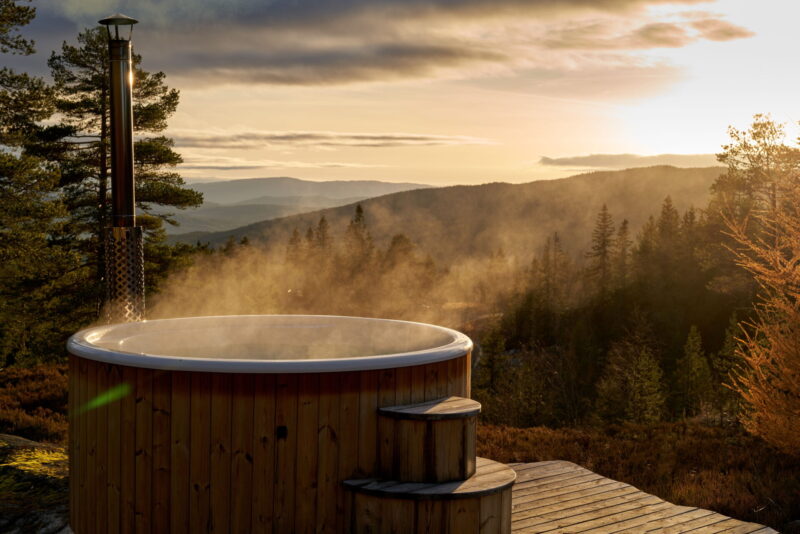
A hot tub, or jacuzzi as many people call it, should be between 37°C and 39°C for most adults, and it should never go above 40°C. Start at 37 to 38°C, which feels warm without working against your body, and only go up a degree at a time. On a cold winter night 39°C is lovely; on a warm summer evening 35 to 36°C is often more comfortable.
Get it right and the first step in feels like slipping into a warm bath outdoors. Your shoulders drop, steam lifts off the water into the cold air and you can sit and talk for a quarter of an hour without feeling light-headed. Get it wrong and the water either feels flat and cool, or so hot that everyone is perched on the edge within five minutes.
This guide gives you the figures to work from: the safe range, the maximum, the right setting for children, pregnancy, winter and summer, and how long to stay in. It also covers something most hot tub guides skip, which is how you control the temperature of a wood fired hot tub with no thermostat. We have been building wood fired hot tubs in the UK since 2014 and deliver across mainland Britain, so this is the advice we give our own customers.
What temperature should a hot tub be for most adults?
Most adults are comfortable at 37 to 39°C (98.6 to 102°F). Your body sits at about 37°C, so water at this level warms you without forcing your body to work hard to cool down.
The US Consumer Product Safety Commission says 38°C (100°F) is considered safe for a healthy adult and that water should never exceed 40°C (104°F) (CPSC). The UK Health and Safety Executive notes that spa pools usually run between 30°C and 40°C (HSE, HSG282). So there is a wide range to choose from, and the right figure depends on who is in the water, the weather and how long you plan to soak.
Here is the full scale, from cool to the maximum.
Hot tub and jacuzzi temperature guide at a glance (°C and °F)
| Temperature | Fahrenheit | How it feels | Best for |
|---|---|---|---|
| 30 to 34°C | 86 to 93°F | Cool and refreshing | Hot summer days, a long lazy soak, keeping water warm between uses |
| 35 to 36°C | 95 to 97°F | Gently warm | Children (with an adult), warm evenings, people who feel the heat |
| 37 to 38°C | 98.6 to 100°F | Warm and relaxing | Most adults, most of the year. The best starting point |
| 39°C | 102°F | Hot | Cold winter nights. Keep soaks shorter |
| 40°C | 104°F | Very hot | The safe maximum. Not for children or pregnancy |
| Above 40°C | Above 104°F | Too hot | Not recommended for anyone |
Sources: CPSC; HSE HSG282; CDC. Figures are general guidance for healthy adults.
The takeaway: set 37 to 38°C as your default and treat 40°C as a ceiling, not a target.
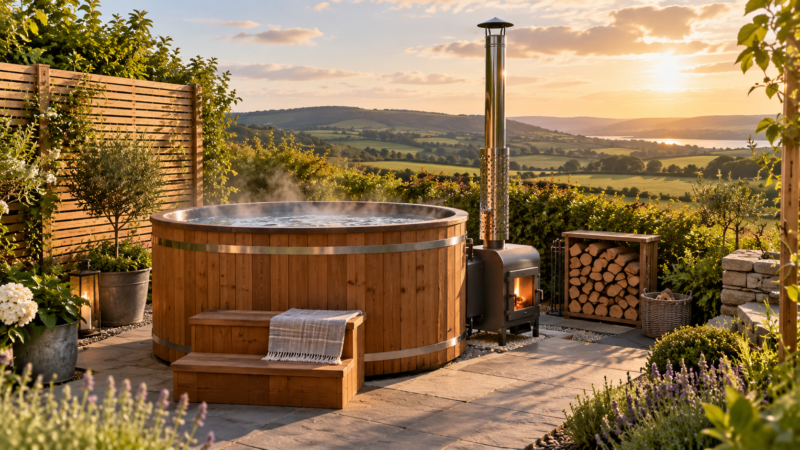
What temperature should a jacuzzi be?
A jacuzzi should be the same as any hot tub: 37 to 39°C, and never above 40°C (104°F). Jacuzzi is a brand name that many people in the UK use for any hot tub, so the guidance on this page applies whether yours is a wood fired tub, an electric spa or an inflatable.
Worth knowing: If you have a heart condition, high or low blood pressure, are pregnant, or take medication that causes drowsiness, speak to your GP before using any hot tub. This guide is general information, not medical advice.
What is the maximum safe hot tub temperature?
The maximum safe hot tub temperature is 40°C (104°F). Both the CPSC and the US Centers for Disease Control and Prevention say hot tub water should not be higher than 40°C (CDC), and the European standard for domestic hot tubs, BS EN 17125:2018, covers their safety requirements.
Above 40°C your body cannot shed heat into the water, so your core temperature climbs. The HSE warns that prolonged immersion in water above body temperature can lead to delayed shock, and that warm water can be a risk for pregnant users and people with some health conditions (HSE, HSG282).
- Signs you are too hot. Dizziness, a pounding heart, nausea, a headache or feeling faint. Get out slowly, sit somewhere cool and drink water.
- What overheating can lead to. Staying too long in water that is too hot can cause dehydration, heat exhaustion and fainting, and a faint in deep water is a drowning risk.
- In Fahrenheit. 40°C is 104°F. So 105°F, 106°F or 110°F is too hot for anyone, and 90°F (32°C) is safe but feels cool.
- Why 41°C is not “just one degree more”. The gap between 40°C and 41°C is where heat stress builds quickly, especially if you stay in for more than 10 minutes.
- Do not trust a single reading. The CPSC notes that thermostats can be out by as much as 2°C (4°F), so check with an accurate thermometer.
Worth knowing: Many electric hot tubs have a thermostat that caps the temperature. A wood fired hot tub has no thermostat, so it is your job to stop it going higher. We explain how below.
What is the minimum temperature for a hot tub?
There is no safety minimum for a hot tub. Below about 30°C (86°F) the water feels cool rather than warm, so most people treat 30°C as the bottom of the hot tub range and 36°C as the point where it starts to feel properly warm.
A hot tub does not have to be hot. On a summer afternoon a cool tub is a pleasant way to cool off, and cold water bathing has its own following. If cold dips are what you are after, our Ice Tub is built for it: its optional chiller works between 3°C and 42°C, so the same tub can run as a cold plunge or a warm soak.
- How cold is too cold outside? There is no air temperature too cold for a wood fired hot tub, and frosty nights are when it feels best. The real risk is the water freezing in the tub and stove when they are not in use.
- Can you lower the temperature of a hot tub? Yes. With a wood fired tub, stop feeding the fire, open the lid and add cold water. With an electric tub, turn the setting down on the control panel.
Worth knowing: Cool water still needs looking after. The HSE notes that bacteria can grow rapidly between 20°C and 45°C, so treat or change the water even if you keep it cool.
What temperature should a hot tub be for children?
For children, keep the water cooler, around 35 to 36°C, and keep soaks short, around 5 to 10 minutes, with an adult in or beside the tub at all times. The CDC advises that children under 5 should not use hot tubs at all (CDC).
Children heat up faster than adults because they are smaller, so water that feels pleasant to you can overheat them. Our product FAQs suggest you “lower the temperature a little” when children use the tub, and we would always start lower rather than higher.
- Let the fire die down or add cold water until the thermometer reads 35 to 36°C.
- Stir the water so there are no hot pockets near the stove outlet.
- Set a timer for 10 minutes and get them out to cool off.
- Never let children use a wood fired hot tub alone, and never let them touch or feed the stove.
Our guide to whether wooden hot tubs are safe for children covers supervision, stove guards and lids in more detail. A chimney heat guard is worth adding if young children will be around the tub.
Worth knowing: Babies and toddlers should stay out of hot tubs. If your child has a medical condition, ask your GP first.
What temperature should a hot tub be if you are pregnant?
If you are pregnant, keep the water at or below 38°C (100°F), keep soaks short, and speak to your midwife or GP before you use a hot tub. The CPSC advises pregnant women to stick to 38°C and warns that soaking above 39°C (102°F) in the first three months may be harmful (CPSC). The CDC also advises talking to a healthcare provider first (CDC).
In practice that means sitting with your shoulders out of the water, getting out at the first sign of feeling hot, and skipping the tub entirely if you feel unwell. Ask for advice that fits your stage of pregnancy.
Worth knowing: This is a summary, not medical advice. Your midwife or GP is the right person to ask.
What temperature should a hot tub be in winter and summer?
In winter, 38 to 39°C feels best because the cold air on your shoulders cools you. In summer, drop to 35 to 37°C, or lower on a hot afternoon, so the soak stays refreshing.
Seasonal settings we suggest to our customers
| Season | Air temperature | Suggested water | Tip |
|---|---|---|---|
| Winter | Below 8°C | 38 to 39°C | Keep the lid on between soaks and wear a hat |
| Spring and autumn | 8 to 16°C | 37 to 38°C | The easiest time to hold a steady heat |
| Summer | 17 to 24°C | 36 to 37°C | Heat up later in the day, use less wood |
| Heatwave | 25°C and above | 30 to 35°C | A cool dip is often better than a hot soak |
Royal Tubs guidance. Adjust to what feels comfortable and never exceed 40°C.
Winter is when a wood fired hot tub really comes into its own. The contrast of hot water and frosty air is the reason many people buy one, and you can read how to use yours through the coldest months in our FAQ on using a wood fired hot tub in winter.
Worth knowing: In freezing weather, water left in the tub and stove can freeze and damage them. Our user manual explains when to drain the tub and stove fully.
How do you control the temperature of a wood fired hot tub?
You control a wood fired hot tub with the fire, not a dial. Feed the stove to heat the water, open or close the air vent to speed up or slow the burn, stir the water, and check it with a thermometer. When you reach your temperature, stop adding wood.
This is the part most hot tub guides miss, because they are written for electric tubs with a control panel. A wood fired tub such as our Deluxe Off-Grid has a 35 kW stainless steel stove that can raise the temperature quickly, so a little attention goes a long way.
- Fill the tub to about 10 cm from the top before you light the stove. The water must cover the hot water outlet.
- Light the fire with dry, seasoned hardwood (under 20% moisture) and keep a strong burn going. See our FAQ on what firewood to buy.
- Stir every 20 to 30 minutes with a stirring paddle. Hot water rises and gathers near the stove outlet, so the surface can read several degrees warmer than the water by your feet.
- Check the temperature after stirring, with a floating or digital pool thermometer held below the surface.
- At about 1 to 2°C below your target, stop adding wood and close the air vent. The water keeps rising a little as the fire burns down.
- Too hot? Add cold water from a hose and stir again. If it still feels too hot, get out.
Prefer push-button control? Our tubs are also offered with electric and diesel heater options on the product pages, and we can talk you through how each is controlled. On an electric or inflatable hot tub you simply raise or lower the setting on the control panel, then check it with a thermometer, because a panel reading can be out by a degree or two.
The vent is your throttle. Open it for a hotter, faster burn and close it to slow the fire. Our heater options guide explains how internal and external heaters differ, and our instructional videos show the routine step by step. For the full picture of how the stove and water circulate, read how wood fired hot tubs work.
Worth knowing: Never touch the stove while it is lit, and never drain the tub until the fire is completely out. If you would rather set a number and walk away, an electric heater option suits you better than wood alone.
How long does a hot tub take to heat up to 38°C?
Most of our wood fired hot tubs reach 38 to 40°C in around 2 to 3 hours from cold, and often under 2 hours in summer. A cover and shelter from the wind can cut heating time by roughly 20 to 30%.
Typical heat-up times from the product specifications
| Model | Seats | Water | Summer | Winter | From |
|---|---|---|---|---|---|
| Ofuro Off-Grid | 2 | 800 l | ±1.5 hrs | ±2.5 hrs | £3,850 |
| Ofuro Premium | 2 | 800 l | ±1.5 hrs | ±2.5 hrs | £4,250 |
| Deluxe Off-Grid | 6 to 8 | 1,200 l | ±1.5 hrs | ±2.5 hrs | £4,900 |
| Deluxe Premium | 6 to 8 | 1,200 l | ±1.5 hrs | ±2.5 hrs | £5,500 |
| Square Hot Tub | 6 to 8 | 1,300 l | ±2 hrs | ±3 hrs | £6,595 |
| Wooden Hot Tub | 6 to 8 | 1,800 l | ±3 hrs | ±4 hrs | £3,250 |
Source: royaltubs.co.uk product pages, October 2026. Times depend on starting water temperature, weather and wood quality. Prices change, so check each product page.
The pattern is simple: more water and colder weather mean a longer wait. An insulated lid and a fitted liner hold the heat in, so you use less wood and wait less. For a model-by-model comparison, see our buyer’s guide and our guide to choosing the right size.
Worth knowing: Starting with water from a cold outside tap in January will add time. Filling from a warm supply, where you have one, is the quickest shortcut.
How long should you stay in a hot tub?
At 37 to 39°C, 15 to 20 minutes at a time is a sensible limit for healthy adults, then get out, cool down and drink water. The hotter the water, the shorter the soak. Nationwide Children’s Hospital advises adults to spend no more than 10 to 15 minutes in a hot tub (Nationwide Children’s), and the HSE’s example guidance for commercial spa pools is no more than 15 minutes’ immersion at a time (HSE, HSG282).
How long to soak at each temperature
| Water temperature | Suggested soak | Then |
|---|---|---|
| 35 to 36°C | 20 to 30 minutes | A short break and a drink |
| 37 to 38°C | 15 to 20 minutes | Step out for 5 to 10 minutes |
| 39°C | 10 to 15 minutes | Cool down fully before going back in |
| 40°C | 10 minutes at most | Get out at the first sign of feeling hot |
Royal Tubs guidance based on HSE and Nationwide Children’s advice for healthy adults.
- Skip the alcohol. The CPSC warns that drinking in a hot tub can cause drowsiness, and our manual is clear: do not use the tub under the influence of alcohol.
- Never bathe alone. Have someone with you, especially late at night.
- Sit up on the step. If you feel warm, sitting higher with your shoulders out lets you cool without getting out.
- Running a holiday let or hire business? The HSE’s spa pool guidance, HSG282, also covers domestic-type hot tubs used in a business, such as holiday rental units (HSE). Our guide to hot tubs for holiday lets explains what that means, and our hot tub hire page shows the tubs we rent out.
Used sensibly, regular warm soaks can help you relax and sleep. Read more in our guide to hot tub health benefits.
What temperature should a hot tub be when not in use?
An electric hot tub is usually kept a few degrees below your soaking temperature between uses, or in its economy mode. A wood fired hot tub is different: it simply cools down when the fire goes out, and you reheat it next time.
With the lid on, a well insulated tub can still be pleasantly warm the next day, so a quick top-up fire brings it back up much faster than heating from cold. That is one reason a wood fired tub can be cheaper to run than an electric hot tub. Our tips on reducing hot tub running costs cover lids, shelter and wood.
- Warm water needs clean water. The HSE notes that bacteria such as legionella can grow rapidly between 20°C and 45°C, which is exactly the range a hot tub sits in (HSE, HSG282). Change or treat the water regularly.
- Chemicals and heat work together. If you treat your water, read whether you can use chemicals in a wood fired hot tub, and consider the 316 stainless steel heater upgrade.
- Cleaning is easier when the tub is cool. Our guide to cleaning a wood fired hot tub explains the routine.
Worth knowing: Water left standing warm for days without treatment is a hygiene risk. If you do not treat the water, drain and refill more often.
Why is my hot tub not getting up to temperature?
If a wood fired hot tub is not reaching 38°C, the cause is almost always the wood, the wind, the lid or the vent. Fix those four and most tubs heat in the times shown above.
- Wet or soft wood. Damp wood burns cool and smoky. Use seasoned hardwood under 20% moisture or heat logs.
- The fire is too small. Keep a strong, steady burn and feed it regularly. A larger tub can need 6 to 8 good logs to heat from cold. With an internal heater, do not load more than two thirds of the heater’s height.
- The lid is off. An open tub loses heat from the surface all the time. Keep the lid on while you heat.
- Wind and cold. A breeze strips heat fast. Shelter the tub, and expect winter heating to take about an hour longer.
- The vent is closed. A closed air vent starves the fire. Open it fully while heating, then close it down once you are near your target.
- You have not stirred. An unstirred tub can be hot at the top and cold at the bottom, so the thermometer may be misleading you.
For a step-by-step routine, see our user manual or call us on 01536 606040.
Worth knowing: If the water level drops below the stove’s hot water outlet, stop the fire straight away. Running the stove without water flowing through it can damage it.
How full should a hot tub be?
Fill a wood fired hot tub to about 10 cm below the top before you light the stove. The water must always sit above the stove’s hot water outlet so it can circulate.
Fill too low and the stove cannot circulate the water. Fill right to the brim and it will overflow when people get in. Around 10 cm from the top leaves room for bathers and keeps the stove working safely, as set out in our user manual.
How do you check the temperature accurately?
Stir first, then measure about 30 cm below the surface with a pool thermometer. The surface of a wood fired tub can read several degrees hotter than the water lower down, so a reading taken without stirring can mislead you.
- Stir the whole tub for a minute with the paddle.
- Hold a floating or digital pool thermometer below the surface, away from the stove outlet.
- Wait 30 seconds for the reading to settle.
- Test with your hand or elbow too. If it feels too hot, it is too hot.
A floating thermometer can be left in the water while you heat it, so you can watch it climb without opening the lid each time. See which extras are worth it in our guide to hot tub accessories.
Is a wood fired hot tub right for you?
A wood fired hot tub suits you if you enjoy the ritual of lighting a fire, want a tub with no electrics to run, and are happy to spend 2 to 3 hours bringing it up to 38°C. It does not suit you if you want to step out of the back door into 38°C water at any hour without planning ahead. For that, an electric heater option or an electric hot tub is the better choice.
If you are weighing it up, start with our range of wood fired hot tubs, read the buyer’s guide, or see what owners say in our customer reviews. We offer finance options and delivery across mainland Britain. Once your tub is at the perfect 38°C, with the stars out and the fire crackling, you will understand the Secret of Royal Tubbing.
Talk to Royal Tubs
If you have a question about temperatures, heat-up times or which tub suits your garden, our team is happy to help.
- Phone. 01536 606040, Monday to Friday 9am to 5pm, Saturday 10am to 1pm.
- WhatsApp. 07310 959595
- Email. info@royaltubs.co.uk
- Showroom, by appointment. Ash Tree Farm, Stoke Albany Road, Kettering, Northamptonshire, NN14 2SP. Book a visit or send a message.
Frequently asked questions
What temperature should a hot tub be?
Most adults are comfortable at 37 to 39°C (98.6 to 102°F). Start at 37 to 38°C and raise it a degree at a time. Never go above 40°C (104°F).
What is the ideal hot tub temperature?
The ideal temperature for most people is 38°C (100°F). It feels warm and relaxing, and the CPSC considers it safe for a healthy adult.
Is 40°C too hot for a hot tub?
40°C is the safe maximum, not a comfortable everyday setting. Limit soaks at 40°C to about 10 minutes and get out if you feel dizzy or your heart is racing.
Is 42°C too hot for a hot tub?
Yes. 42°C is above the 40°C maximum recommended by the CPSC and CDC, and your body cannot cool itself in water that hot. Add cold water and stir until it reads 40°C or below.
What temperature should a hot tub be for kids?
Keep it around 35 to 36°C for children, with soaks of 5 to 10 minutes and an adult watching at all times. The CDC advises that children under 5 should not use hot tubs.
What temperature should a hot tub be when pregnant?
Keep it at or below 38°C (100°F), keep soaks short and speak to your midwife or GP first. The CPSC warns against soaking above 39°C in the first three months.
What temperature should a hot tub be in winter?
38 to 39°C works well in winter because the cold air cools your shoulders. Keep the lid on between soaks so you do not lose heat.
What temperature should a hot tub be in summer?
35 to 37°C is usually more comfortable in summer. On a very hot day, 30 to 35°C makes a refreshing dip.
How long does a wood fired hot tub take to heat up?
Most Royal Tubs models reach 38 to 40°C in about 2 to 3 hours from cold, and often under 2 hours in summer. The 800 litre Ofuro is quickest at around 1.5 hours in summer, and the 1,800 litre Wooden Hot Tub takes longest at around 3 to 4 hours.
How do I cool down a hot tub that is too hot?
Stop adding wood, close the stove’s air vent, add cold water from a hose and stir. Leaving the lid off for a while also helps the water cool.
How long can you stay in a hot tub at 38°C?
15 to 20 minutes at a time is a sensible limit for healthy adults at 38°C. Then get out for 5 to 10 minutes, cool down and drink water before going back in.
Is 30 degrees hot enough for a hot tub?
30°C feels cool rather than hot. It is pleasant for a dip on a hot summer day, but most people want 36 to 38°C for a relaxing soak.
What temperature is safe for older people?
Older people are often more sensitive to heat, so 36 to 37°C and shorter soaks are a sensible start. Anyone with a heart condition or blood pressure problems should speak to their GP first.
What temperature should I leave my hot tub on overnight?
An electric tub is usually left a few degrees below your soaking temperature or in economy mode. A wood fired tub simply cools once the fire is out; keep the lid on and it will still be warm the next day, which shortens the reheat.
What temperature should a jacuzzi be?
The same as any hot tub: 37 to 39°C (98.6 to 102°F), and never above 40°C (104°F). Jacuzzi is a brand name that many people use for any hot tub.
Is 104°F too hot for a hot tub?
104°F (40°C) is the maximum safe temperature, so it is the limit, not a target. Anything above it, such as 106°F or 110°F, is too hot.
What is the lowest temperature for a hot tub?
There is no safety minimum. Below about 30°C the water feels cool, and most people find 36°C the point where it starts to feel warm.
Is a hot tub safe with high blood pressure or a heart condition?
Hot water affects your heart rate and blood pressure, so get your GP’s advice before using any hot tub. If they are happy, keep the water cooler and the soaks shorter.
Should men and women use different temperatures?
No. There is no official guidance that sets different temperatures for men and women. Comfort, health and how long you stay in matter far more.
Does a wood fired hot tub have a thermostat?
No. You control the temperature with the fire, the air vent and cold water, and check it with a thermometer after stirring. If you want thermostatic control, ask us about electric heater options.