Nationwide UK Delivery
 Built in the UK
 Finance available
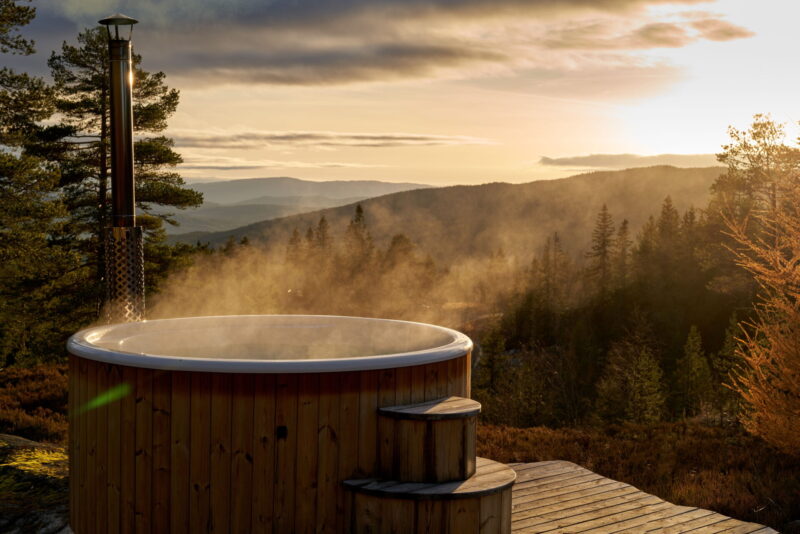
A wood fired hot tub heats its water with a wood-burning stove instead of electricity. The fire warms a sealed steel firebox sitting in or beside the tub, the water touching that steel heats and rises, and cooler water sinks to take its place. That circulation is what warms the whole tub, with no pump involved.
There is a moment, about an hour after you light the stove, when the smell of woodsmoke drifts across the garden and the water begins to move on its own. No pump, no timer, no app to open. Just fire and water doing what they have always done.
That is the part people fall for. It is also the part that makes wood fired hot tubs work very differently from the plastic box with a plug on the side. This guide explains the mechanics: what happens inside the stove, how long heating really takes, how much wood you will burn, what it costs to run, and, honestly, where a wood fired tub is the wrong answer. Royal Tubs has been handcrafting these in the UK for 12 years, so the figures here are our own.
How does a wood fired hot tub work?
A wood fired hot tub works by thermosiphon. Burning wood heats a steel firebox that sits in contact with the water. Heated water becomes less dense and rises, cooler water sinks toward the firebox, and the loop repeats until the whole tub is at soaking temperature. No pump or electricity is needed to move the water.
Physics does the stirring. The only job you have is keeping the fire fed.
The heating loop, step by step
- Fill the tub with a garden hose until the water covers the top of the firebox. Never light the stove before this: a dry firebox will warp.
- Light the stove and close the door. The chimney draws air through the firebox and the fire settles within a few minutes.
- The steel firebox heats. Because it is submerged, or wrapped by the water jacket on an external stove, the heat passes straight into the water rather than into the air.
- Warmed water rises off the steel and drifts across the surface. Cooler, denser water slides down to replace it.
- That circulation runs continuously while the fire burns, until the whole tub sits at temperature, usually between 37°C and 40°C.
A stirring paddle comes with every Royal Tubs hot tub for one reason: near the end of the heat-up, the top third of the tub is warmer than the bottom. Thirty seconds of stirring evens it out and tells you the tub is ready.
What are the parts of a wood fired hot tub?
A wood fired hot tub has six essential parts: the tub shell, an internal or external wood-burning stove, a chimney, an insulated lid, a drain valve and steps. Lined tubs add an acrylic, fibreglass or polypropylene liner inside the timber shell.
| Part | What it does | Why it matters |
|---|---|---|
| Stove and firebox | Burns the wood and transfers heat directly into the water | The single biggest factor in how fast the tub heats. 304-grade stainless steel is standard, 316-grade resists chemicals |
| Chimney | Draws air through the fire and carries smoke above head height | A poor draw means a sulky fire and a slow heat. Add a chimney guard if children will be near the tub |
| Tub shell | Holds the water and carries the load | Timber staves held by stainless steel straps, or a timber-clad shell around a moulded liner |
| Liner | A smooth, shaped inner surface in acrylic, fibreglass or polypropylene | Easier to clean, more comfortable to sit in, and it does not need the timber to swell before it stops weeping |
| Insulated lid | Holds heat in while thoe tub warms and between soaks | Leave it off during heat-up and you will burn noticeably more wood |
| Drain valve | Empties the tub | A high-flow tap saves a long wait on emptying day |
| Steps | Get you in and out safely | Wet timber and a high rim are not a good combination without them |
For the full run-through of every option, including jets, bubbles, lighting and cladding, our buyer’s guide goes deeper, and there is an honest verdict on which accessories are worth adding.
Internal or external stove: which is better?
An internal stove sits inside the tub and heats fastest, because the steel is surrounded by water on every side, but it takes up bathing space. An external stove sits beside the tub, freeing the whole interior for seating, and heats slightly more slowly. Royal Tubs fits an external integrated stove as standard on most models.
- Internal stove: quickest heat-up, most efficient use of wood, lowest cost. Costs you roughly one seat and puts a hot surface inside the tub, so a guard is sensible.
- External stove: full bathing space, easy to load without leaning across the water, nothing hot inside the tub. Sits up to 1 metre away and needs a little more room in the garden.
- External integrated stove: tucked tight against the tub wall so it reads as part of the tub. The standard fit on the Deluxe and Ofuro ranges, and the option most of our customers choose.
There is more detail, including diesel and low-profile options, in heater options explained.
How long does a wood fired hot tub take to heat up?
Most Royal Tubs hot tubs reach soaking temperature in about 1.5 hours in summer and 2.5 hours in winter, from cold mains water. The larger, deeper Square Hot Tub takes about 2 hours in summer and 3 hours in winter. Keeping the insulated lid on while it heats makes a real difference.
| Model | Water | Summer | Winter |
|---|---|---|---|
| Deluxe Premium | 1,200 L | 1.5 hours | 2.5 hours |
| Deluxe Premium PLUS | 1,200 L | 1.5 hours | 2.5 hours |
| Ofuro Premium | 800 L | 1.5 hours | 2.5 hours |
| Square Hot Tub | 1,300 L | 2 hours | 3 hours |
| Wooden Hot Tub | 1,400–2,700 L | 1.5–2 hours | Allow longer for the 2.2 m size |
Four things change those numbers. Cold mains water in January starts around 5°C rather than the 15°C you get in July, so winter simply has further to climb. Dry wood burns hotter than damp. A lid left off vents heat straight into the sky. And a bigger tub holds more water to warm, which is why the size you choose matters more than people expect: our size guide walks through it.
How much wood does a wood fired hot tub use?
A wood fired hot tub uses roughly one bag of logs, around 10 kg, to heat from cold and hold temperature through an evening. Expect to load the stove two or three times during heat-up, then add a log every 30 to 40 minutes while you soak.
Hardwood is the better buy. Ash, oak, birch and beech burn hotter and longer than softwood, so you open the stove door less often. Softwood lights beautifully and is perfect for getting started, but it burns through fast.
What matters more than the species is how dry it is. Wood sold in England in quantities under 2 cubic metres must be certified “Ready to Burn”, which means a moisture content of 20% or less. Damp wood spends its energy boiling off water instead of heating yours, and it is the single most common reason a tub takes twice as long as it should. A cheap moisture meter pays for itself in a season. There is more on fuel and efficiency in why wood-fired stoves.
What does a wood fired hot tub cost to run?
The running cost of a wood fired hot tub is firewood plus water, and nothing else when the tub is not in use. Unlike an electric hot tub, which draws power continuously to hold the water hot, a wood fired tub costs nothing between soaks because there is nothing to keep running.
That is the honest shape of it. You pay per soak rather than per month. If you use a tub twice a week, the sums usually favour wood. If you want to drop in for twenty minutes every single evening, an electric tub that is already hot will win on convenience, and the standing cost stops looking so bad.
We put real numbers against both in our cost comparison with electric tubs, and there are practical savings in how can I reduce the running costs of my hot tub.
Do you need electricity or plumbing?
No. Heating a wood fired hot tub needs no electricity and no plumbing. You fill it from a garden hose and drain it through a valve to a soakaway or drain. Electricity is only required if you add jets, an air bubble system, underwater lighting or filtration.
That independence is why these tubs turn up on allotments, in woodland, at glamping sites and at the far end of gardens where running a supply would cost more than the tub. Two of our models, the Deluxe Off-Grid and the Ofuro Off-Grid, are built with no electrical parts at all: no pump, no jets, no control panel, nothing to fail in a wet field.
A word on weight. A filled tub sits at upwards of 1,500 kg, so the ground underneath needs to be firm and level, though no concrete base is required. Allow the tub’s footprint plus at least 50 cm clear on every side so you can reach the stove and get around it. The full list is in what you need to install a tub like this.
How do you keep the water clean?
How often you change the water depends on whether the tub is lined and filtered. An unlined wooden tub used without chemicals needs fresh water every 2 to 3 days. Add a filter and treat the water and you can go weeks between changes, and months on a filtered acrylic-lined tub.
A submersible Skimatic filter can be added to most models for £200 and is the single upgrade that changes daily life with a hot tub the most. If you plan to use chemicals, specify the 316-grade stainless steel stove rather than the standard 304: chlorine and bromine are hard on steel.
Full method, dosing and the case for and against chemicals: cleaning made easy and can I use chemicals in a tub like this.
How long does a wood fired hot tub last?
With annual oiling, a spruce tub lasts around 10 years and a larch tub 20 years or more. Acrylic-lined tubs typically outlast their timber cladding, because the liner is unaffected by water, and the cladding can be replaced. Every Royal Tubs hot tub carries a 2-year warranty.
One quirk worth knowing. A new all-timber tub may weep a little on its first fill. That is not a fault: the staves are taking up water and swelling to seal their own joints, usually within 3 to 5 days for spruce. A lined tub skips this entirely. The longer view is in how long do wooden hot tubs last and the woods we use.
Wood fired or electric: which should you choose?
Choose wood fired if you soak once or twice a week, want no standing cost, or have no power at the site. Choose electric if you want hot water on twenty minutes’ notice, every day, without handling logs or ash. Both are good tubs. They suit different habits.
| Wood fired | Electric | |
|---|---|---|
| Time to hot | 1.5 to 3 hours from cold | Already hot, or 4 to 24 hours from cold |
| Cost when not in use | Nothing | Continuous power to hold temperature |
| Effort per soak | Light the fire, feed it, clear the ash | Lift the lid |
| Power needed | None for heating | A dedicated supply, usually an electrician’s job |
| Where it can go | Anywhere firm and level, including off-grid | Within reach of a suitable supply |
| The experience | Firelight, woodsmoke, a ritual that takes an evening | Convenience, on demand |
We build wood fired tubs, so we are not neutral. But we would rather you bought the right thing: if the honest answer is that nobody in your house will want to light a fire on a wet Tuesday, an electric tub will make you happier.
Are wood fired hot tubs allowed in the UK?
Yes. A freestanding hot tub in a domestic garden does not normally need planning permission, and England’s smoke control rules apply to chimneys serving buildings rather than to a garden stove. You do need to buy the right fuel: wood sold in quantities under 2 cubic metres must be certified “Ready to Burn” at 20% moisture or less.
- Planning: check with your local planning authority first if you are in a conservation area, a national park, or the grounds of a listed building, where permitted development rights can be restricted.
- Fuel: buy certified “Ready to Burn” logs, or season your own to below 20% moisture. It is better fuel anyway, and it produces far less smoke.
- Neighbours: think about where the smoke will drift before you decide where the tub goes. Position the chimney away from a neighbour’s windows and washing line and the question never comes up.
- Bonfire rules: burning garden waste or treated timber in a hot tub stove is a genuinely bad idea, for your steel as well as your neighbours.
Is a wood fired hot tub right for you?
If you like the idea of an evening that starts with splitting kindling and ends under the stars with the fire ticking beside you, then yes. If you want a button, then no, and there is no shame in that.
What surprises most owners is that the fire stops being a chore within a month and becomes the point. The crackle of burning wood, the soulful aroma of cut timber warming in the steam, the slow hour where nothing much is asked of you. That is the Secret of Royal Tubbing, and it is not something an electric tub can offer.
Ready to look at models? Compare every tub, size and price, see how one will look in your own garden before you order, or talk to our team. Everything we make is handcrafted in the UK, and in-stock models ship in 1 to 3 days.
Frequently asked questions
How does a wood fired hot tub work?
A wood-burning stove heats a steel firebox that sits in contact with the water. Heated water rises, cooler water sinks to replace it, and that circulation warms the whole tub without a pump. Royal Tubs models reach temperature in about 1.5 hours in summer and 2.5 hours in winter.
Do wood fired hot tubs need electricity?
No. Heating needs no electricity at all. Power is only needed for optional extras such as massage jets, air bubbles, LED lighting or filtration. The Deluxe Off-Grid and Ofuro Off-Grid are built with no electrical parts.
How much wood does a wood fired hot tub use per soak?
Around one bag of logs, roughly 10 kg, to heat from cold and keep the water hot through an evening. Use hardwood at 20% moisture or less and you will open the stove door less often.
How hot does a wood fired hot tub get?
Comfortable soaking temperature is 37°C to 40°C, and a wood fired stove will take the water past that if you keep feeding it. Check with a thermometer and stop adding wood once you reach your temperature, because there is no thermostat to do it for you.
Can you use a wood fired hot tub in winter?
Yes, and winter is when they are best. Heating takes about an hour longer than in summer because the mains water starts colder. If you are leaving the tub unused through a hard frost, drain it so nothing is left standing to freeze.
How often do you change the water?
Every 2 to 3 days in an unlined wooden tub used without chemicals. Adding a submersible filter extends that to weeks, and a filtered, treated acrylic-lined tub can run for months. Cleaning made easy has the detail.
Do you need planning permission for a wood fired hot tub in the UK?
Not normally. A freestanding hot tub in a domestic garden is usually permitted development. Check with your local planning authority if your property is listed or sits in a conservation area or national park.
How much does a wood fired hot tub cost?
Royal Tubs wood fired hot tubs start from £3,250 for the Wooden Hot Tub, with the two-person Ofuro Premium from £4,250 and the Deluxe Premium from £5,500. Every tub includes its stove, chimney and steps. Compare all models and prices.